
The pressure on small businesses is real. In NFIB's October 2026 survey, NFIB's jobs report found 36% of small businesses had openings they couldn't fill. Most owners don't have a recruiting team. Screening and scheduling eat hours, labor costs keep climbing, and candidates still expect a fast, personal experience.
This guide covers definitions, workflows, benefits, risks, and how to choose.
Key Takeaways
- A human virtual recruiter does recruiting work remotely; an AI virtual recruiter automates selected steps.
- Both can handle sourcing, screening, scheduling, and updates, but people should make the final hiring call.
- Hiring volume, role complexity, budget, and management capacity decide the right model.
- Vet providers on screening quality, data protection, tool fit, pricing clarity, and accountability.
What Is a Virtual Recruiter?
A virtual recruiter is anyone or anything that handles recruiting tasks remotely. iCIMS describes virtual recruiting as technology-enabled hiring done without face-to-face contact. The job being filled doesn't have to be remote.
The human version
A remote recruiting professional typically:
- Writes or refines job descriptions
- Sources candidates on job boards and professional networks
- Runs initial phone screens
- Coordinates interviews
- Maintains the applicant tracking system (ATS)
- Sends candidates status updates
The AI version
AI tools may:
- Answer common candidate questions
- Collect application data
- Ask structured pre-screening questions
- Rank or route applicants
- Book conversations
Capabilities vary widely by product. Someone on your team should check AI outputs against job-related criteria.
How it differs from related roles
- Recruiting coordinator: handles scheduling, paperwork, and pipeline admin; duties often overlap with a recruiter's.
- Virtual assistant: general support, not necessarily recruiting-trained.
- Fractional recruiter: part-time recruiting capacity. There's no standard definition or price, so spell out hours and deliverables.
- Staffing agency: owns the search and charges for results.
- In-house recruiter: your employee, on your payroll, in your systems.
The distinction matters when you compare quotes. Hiring a dedicated remote professional buys recruiting capacity. Adopting AI software buys automation and workflow support.
How Does a Virtual Recruiter Work?
Intake
Good providers start with a conversation. They gather the details that shape the search:
- Role requirements and must-have skills
- Pay range and schedule
- Interview steps and decision process
- Ideal candidate profile
- What success in the role looks like
The human-led workflow
- Search job boards and professional networks for candidates who match the role
- Reach out to prospects with clear, role-specific messages
- Review resumes and run qualification screens against your criteria
- Schedule interviews and keep candidates informed at each step
- Hand a shortlist to the hiring manager with notes on fit
Along the way, the recruiter works inside your ATS, scheduling software, email, video conferencing, and shared documents. Use role-based access so they see only what the job requires, and keep records consistent.

The AI-assisted workflow
An application or sourcing event triggers automated messages or questions. The system captures structured answers, then routes qualified candidates to a human. Workday and Paradox, for example, describe two-way texting, reminders, scheduling, and ATS handoffs. That shows what the tools can do. It does not prove better hires.
Candidates need an exit ramp. Offer a way to ask questions, reach a person, request accessibility accommodations, or use another channel. The DOJ's ADA guidance says employers can remain responsible when a vendor's tool screens out people with disabilities.
A sample SMB scenario
A ten-person home services company has four open roles: two technicians, a dispatcher, and an office manager. A virtual recruiter sources and screens for all four, books interviews, and sends weekly pipeline updates. The owner interviews finalists, makes the offers, and handles onboarding. The recruiter clears the busywork; the owner keeps the decisions.
Benefits, Limitations, and Risks of Virtual Recruiting
Benefits
- More recruiting capacity without a full-time hire
- Faster responses to candidates
- Less administrative load on managers
- Access to specialized or global talent
- Staffing that scales up or down
For context, SHRM's 2026 benchmarking puts median nonexecutive time-to-fill at 39 days. That's a baseline, not a virtual-recruiter result. Measure your own numbers first.
The real payoff is leadership time. Owners who stop chasing resumes can spend it on customers, operations, and growth.
Limitations
- Provider quality varies
- Outsiders may miss your culture
- Communication gaps and time zones can slow things down
- Automated screening lacks context
- Speed can crowd out candidate experience
Privacy, security, and compliance
Before you sign, confirm:
- Who can access candidate data
- Where it's stored and how long it's kept
- Which third-party tools touch it
Get confidentiality agreements and audit trails. Keep records as employment law requires.
Never accept a claim that a tool is "bias-free" or automatically compliant. You need documented, job-related criteria, human review, and regular audits.
Rules differ by place: New York City, Illinois, California, Texas, and Colorado each regulate automated hiring tools differently, so confirm what applies to you. This isn't legal advice.
Measuring success
Track these:
- Qualified-candidate rate
- Time to shortlist
- Interview completion
- Candidate response rate
- Hiring-manager satisfaction
- Offer acceptance
- Retention
- Cost per hire
Compare against your current process or a controlled pilot, not just vendor averages. SHRM's 2025 nonexecutive median cost per hire was $1,200, though the average was far higher at $5,475, so context matters.

How to Choose the Right Virtual Recruiter Model
Start with a few questions that match the model to your hiring pattern:
- How often do you hire, and how many roles are open?
- How complex and urgent are the roles?
- Do you have recruiting expertise in-house?
- How much candidate contact do you want to keep human?
- What's the budget, and is the need ongoing or occasional?
| Model | Best fit |
|---|---|
| Dedicated human virtual recruiter | Steady hiring, limited internal capacity |
| Fractional or agency support | Occasional or spiky needs |
| AI recruiting software | High-volume, repeatable roles |
| In-house recruiter | Constant, complex hiring with management bandwidth |
| Blended human and AI | Volume plus a need for judgment |
Vendor due-diligence checklist
- Recruiter qualifications and industry familiarity
- English communication skills
- Sourcing methods and screening standards
- ATS experience
- Backup coverage if the recruiter is out
- Reporting and support availability
- Contract terms, setup fees, and pricing transparency
- Security controls, and the scope and date of any SOC 2 report
One example
SmartScale360 is a staffing partner that gives US small and medium-sized businesses dedicated, college-educated, English-speaking remote staff, primarily from the Philippines.
Its Recruiting Coordinator role covers:
- Sourcing through LinkedIn, job boards, and referrals
- Resume screening and initial phone screens
- Interview coordination and ATS/CRM pipelines
- Candidate communication and hiring metrics
It also offers a Full Cycle Recruiter role and a caregiver recruiter for home care agencies.
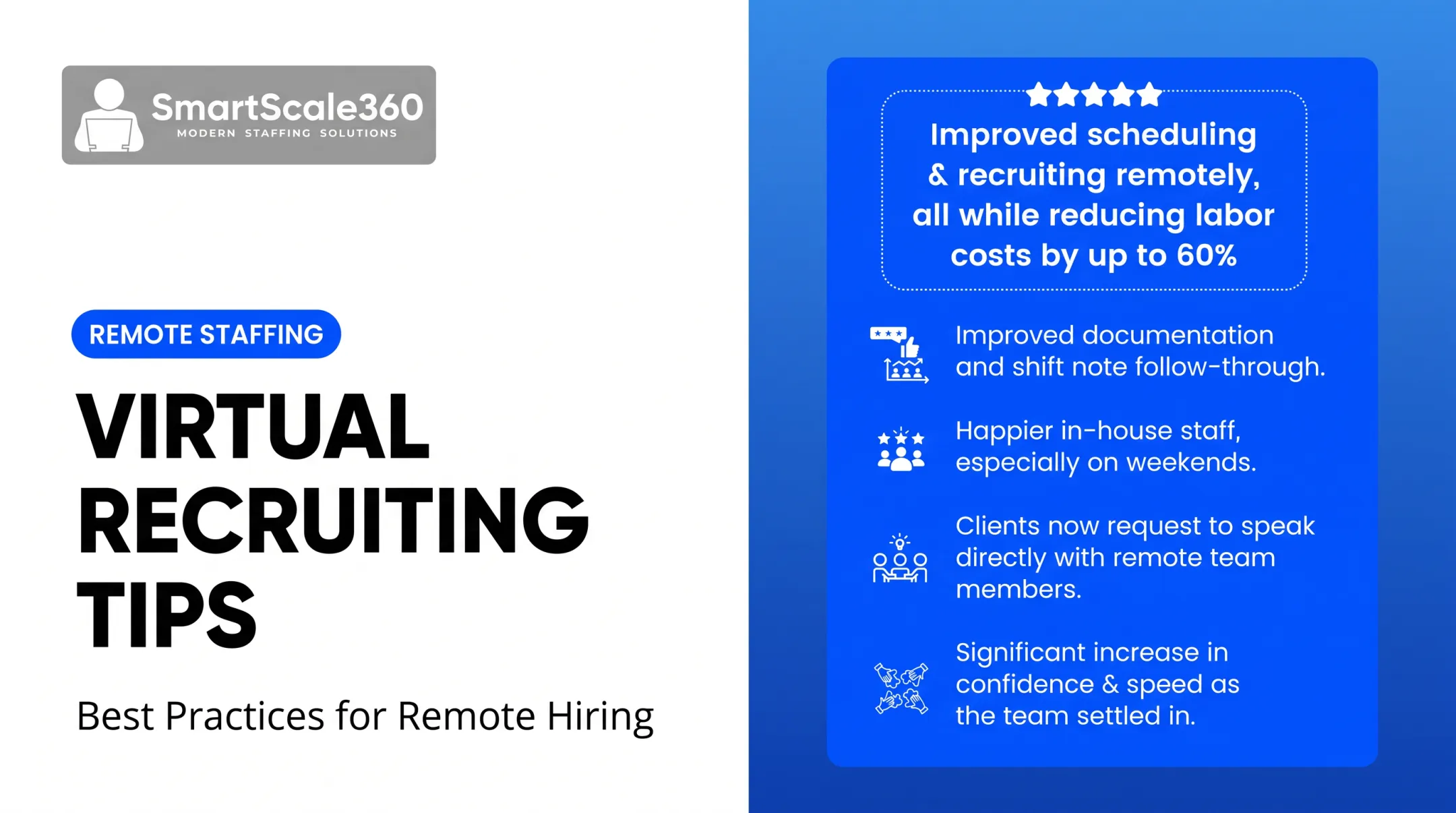
The company lists no contracts, no setup fees, and transparent monthly pricing, and says remote teams can cut labor costs by up to 60%. Treat that as an advertised figure, not a guarantee. Confirm the exact scope, pricing, and data-handling terms for a recruiting role before you sign.
Best Practices for Managing a Virtual Recruiter
Set the brief first
Before work starts, document:
- Ideal-candidate criteria
- Approved messaging
- Screening questions
- Escalation rules and response times
- Interview stages
- Who owns the final decision
Build the working relationship
Agree on a communication rhythm and review the pipeline regularly:
- Share a dashboard
- Put feedback in writing
- Set time-zone expectations
- Give the recruiter enough company information to represent you accurately
Pilot before you scale
Begin with a few roles. Review candidate quality and experience, then expand. Plan for:
- Training
- Access removal when the engagement ends
- Data handling
- Backup coverage
- Ongoing improvement
NIST's AI guidance supports the same idea: test before deployment and keep checking during use, with a person accountable.

Frequently Asked Questions
What is a virtual recruiter?
It's either a remote human recruiter or an AI tool that handles recruiting tasks. Businesses use either model to fill roles without adding full-time, on-site recruiting staff.
Is a virtual recruiter an AI recruiter?
Not necessarily. The term can describe a person working remotely or an AI system. AI is one technology category, not the definition.
What does a virtual recruiter do?
Common duties include sourcing, screening, scheduling, candidate communication, ATS updates, and reporting. They route qualified applicants to the hiring manager.
What is the difference between a virtual recruiter and an in-house recruiter?
Work location, engagement model, and management structure differ. A virtual recruiter works remotely, often under a service agreement, while an in-house recruiter is your employee. Either way, you'll likely need to provide tool access and process training.
How much does a virtual recruiter cost?
It depends on whether you're buying a human professional, an agency, fractional hours, or software. Compare total cost: setup fees, contracts, tools, and your management time.
Are virtual recruiters safe for candidate and company data?
Only if controls are in place. Check access limits, confidentiality terms, secure systems, retention policies, and vendor agreements. If AI is involved, confirm how it uses candidate information.